This exhibition
is dedicated to Belgrade that is no longer here, to the Belgraders who are no
longer here, the Jews, inhabitants of Dorcol. Most of them died during the World
War II, shot or suffocated by poisonous gas in the special truck.
Exhibition is the tribute to the Sephard Jews, who had a compact community in
this part of the city, which highlighted the whole borough. All institutions
were there: Jewish Municipality Offices, synagogues, humanitarian and religious
societies, schools.
Askenasy Jews arrived in Belgrade later and lived in other parts of the city,
and that is the reason why they were not included in this exhibition.
We want to mark one period from the life of this city and his inhabitants who
have lived on the banks of the Sava and Danube for 400 years, and then were
brutally murdered in several months time, during 1941 - 1942. They were destroyed,
and all their property was destroyed. It was forgotten that the streets, houses,
stores and institution buildings we live and work in now, have not always looked
like this. We are trying to call on a disappeared world for a moment, to enliven
the picture of the Jews from Dorcol.
Data on Jews in the territory of Belgrade had existed since the Ancient Roman
times. But, their life can be tracked down with precise certainty from the 16th
century on. Sephards lived on the Danube slope, Jalija and Dorcol, and after
the First World War they slowly progressed towards the Knez Mihajlova Street.
Between the World Wars, some of their prominent and richer shops and stores
were situated in Knez Mihajlova Street and Terazije. All traditional things
remained in Dorcol: synagogues, schools, Jewish Municipality building, offices
of Jewish organizations...
Our exhibition could not show all the streets in Dorcol where the Jews had lived.
We chose the streets where the main Jewish institutions where situated: Jevrejska,
Solunska, Cara Urosa, Cara Dusana and Kralja Petra Streets.
Jevrejska Street had several important buildings and institutions built by Belgrade
Jews. Ritual bathroom, micwa, was situated at the corner of Jevrejska and Solunska
Streets, and that bathroom here used to be called "amam." It is not
certain when this bathroom had been built, but Hebrew sources form 17th century
mention it. On many solemn occasions, such as holidays, procession was passing
down this street, with all sacred things from the nearby synagogue. For the
Jews, it was a part of religious service, and for the other citizens it was
a picturesque sight.
Besides numerous Jewish houses in the Solunska Street, there was one of great
importance: Mildar - Jewish Municipality and school. That building was built
in 1862. Actually, the house had already existed on that year, because documents
tell a very interesting story about it: In the year of 1862, the Turks shelled
the city and Jews from Jalija found shelter in this house for it had been built
of firm material, and was not fragile as their own houses built of mud. Fear
of shelling culminated when a large
cannonball buzzed right above the house, but stopped in the roof of the house,
without exploding at all. As a sign of remembrance of this miraculous salvation,
the Jews left the cannonball in the roof in its place, and the date of the event
had been pronounced for special holiday called "Belgrade Purim."
Synagogue Bet Israel was situated in the Cara Urosa Street. Old photographs
show that it was the highest building in the street by the early 20th century,
so it dominated the street. Fresco gallery was built on the foundations of this
building, after the Second World War.
The Kralja Petra Street is one of the oldest and most interesting streets in
the city. It connects the Sava and the Danube, two banks and the two worlds.
This street has monuments of the Orthodox Christianity, Islam and Judaism. It
is the symbol of religious variety that once existed in Belgrade.
The Dusanova Street had rooms for religious groups, coffee shops where the Jews
frequently had their meetings and the rooms of the Zionist organizations where
the Jewish newspapers were printed.

Historians mention a big
building in "Jewish neighborhood" where the Jews once had lived. But,
there is no trace of that building. Actually, the oldest material monuments
of the Jewish culture in Belgrade are the tombstones. Literature depicts several
such monuments in 16th and 17th century, found in the Sava and the Danube slopes.
Two preserved monuments of that kind are on show at the entrance to the Jewish
Historic Museum.
One is the monument of Abraham Cohen from 1641, the other is the monument of
Donna Clara "who died in 5380" (1619).
The oldest building in the Jewish borough, building which has existed up until
1952, was the Old Synagogue. Almost nothing has remained today of the old Jewish
houses destroyed in the World Wars. However, the buildings of the Jewish institutions
remained. These buildings were erected between the Wars and some of them exist
today, although their use and purpose is completely altered.
These few buildings, the Old Synagogue, the synagogue Bet Israel, Oneg Sabbath
building, Jewish Municipality building and the Jewish Women Society building,
marked the life of every Jew from Dorcol. Tradition and habits linked them to
those buildings throughout their life. All joys and sorrows were shared with
other members of the Jewish community in those buildings. Small male children
were circumscribed in the synagogues. Boys became religious adults and carried
out their religious obligations there, got married there, and prayers were read
for them there when they died. They payed taxes in the Municipality and became
the members of a specific community, gained their rights and duties, and included
themselves in the legal system of the state.
Buildings of the Oneg Sabbath Society and the Jewish Women Society played a
big role in education of the Jewish children. Besides typical educational function
carried out through schools and various courses, life in these buildings also
had great social importance. Spirit of changes in the lives of the Belgrade
Jews can be seen through the happenings in these buildings.
The Oneg Sabbath building was real municipal home, and the Jews from the neighborhood
called it so. Building served for many purposes: religious (that is why many
people thought it was a synagogue), but also for absolutely secular gatherings,
celebrations, weddings, parties, pre-electoral meetings, national political
parties' meetings...
With the development of the youth movement, nature of happenings in this building
slowly turned form religiously-traditional into national-mobilizing.
Erection of the Bet Israel synagogue in the Cara Urosa Street was the sign of
the emancipation of the Belgrade Jews and better economic situation which enabled
the erection of the big and beautiful synagogue, and also the sign of the coming
out of the traditional surroundings of Dorcol. The Old Synagogue will remain
the place of more traditional religious service.
It will be the gathering place for the more unadjustable followers of the faith.
The Bet Israel Synagogue, on the other hand, will be the place for the gatherings
of the more emancipated Jews with civil habits, European spirit, new professions
and vocations. Service was also participated by the choir of the Serb-Jewish
Singing Society, and visited by the members of the government and the Royal
family. Bet Israel was the sign of assimilation, while the Old Synagogue was
the sign of traditionalism.
Role of women in the Jewish community was important and very specific. Woman
is the pillar of the family and she is the carrier of tradition within the family
home. She keeps tradition through language (women rarely spoke Hebrew, and mostly
spoke ladino), costume, nutrition, bringing -up of the children. Since most
of the Sephards were merchants, often absent and away from home for their business
reasons and travels, women took care of the house and the family.
These women started to emancipate themselves in early 20th century. The building
of the Jewish Women Society was the sign of the great changes in the lives of
the Dorcol Jewish women. It meant that young girls can be educated and become
professionals who can earn their daily bread, not dependent on marriage any
longer.
During the occupation, Jews organized their hospital in this building. Whole
personnel and all patients were took away to the concentration camp of Sajmiste
and suffocated by the poisoned gas.
Exhibition shows, besides the pictures from the private lives of many families,
the rise of merchant Alkan-Djerasi, who owned the factory and became one of
the richest members of the Belgrade Jewish community. Between the streets of
Jevremova and Visnjiceva, he had built beautiful big building with apartments
for renting, while he himself had lived in a villa in Jevremova Street No.20.
Today, kindergarten is in that building.
He was a benefactor and donor. Many diplomas and thank-letters from various
organizations he had helped, are preserved.
Building in the Kralja Petra Street No.71, where the Jewish Municipality was
situated until Second WW, was projected by the architect Samuel Sumbul. He also
made blueprints for Alkan-Djerasi building and Oneg Sabbath building. Furniture
of those buildings was dispersed or destroyed during the war. The greatest damage
is the absence of the paintings of Leon
Cohen, renown Belgrade painter. All rooms used to be decorated by his pictures.
Also, great damage is the absence of the library with the books in Hebrew printed
in Belgrade in 19th century, and the books by the Belgrade rabies from 17th
and 18th century, printed in Venice, Krakov, Istambul and other cities.

Writer Hayim S.Davico depicted
the romantic sights of the life of Jewish community in Jalija beside the Danube,
in the late 19th century. He described fragrant gardens full of flowers in the
warm Belgrade summer nights, old Sephard women singing romances, brought from
Spain 400 years before. Young girls listened to them with sadness, for according
to the stories, most youth romances in Dorcol and Jalija had tragic ending.
Patriarchal life, strict rules and duties in the family were ruthless and everyone
obeyed that.
Hayim Davico, besides the tragic destinies of the young beautiful Jewsih girls,
also describes customs and holidays, rooms and decorations, kitchens where traditional
Sephard food with striking names - burmuelos, alharos, pastel - was prepared.
It was the mixture of the Iberian and Oriental influences in the life that gradually
took over the customs of the neighborhood.
After the First WW, picture of the family life has changed. Jews were more educated
and emancipated. Since they were educated in various European centers, they
acquired new ways of behavior and attitude. Dorcol was mostly ruined in the
war, so they started building houses well above the Dusanova Street. There were
no gardens any more. Sitting and singing romances was replaced by going in the
theater, concerts, lectures and exhibitions. Family celebrations were no longer
just a part of tradition, but a chance for showing one's wealth and a chance
for socializing with non-Jew neighbors. Presents and cakes were exchanged, and
expensive dresses shown.
Gradually, there came the habit of renting some of the Dorcol coffee shops for
the family celebrations (most often "Jewish Cassina"). However, Purim
and other celebrations were held in many other coffee shops and inns all the
way to Terazije square.
Drummers and messengers were replaced by nicely printed invitations for wedding
parties. Jewish newspapers were full of advertisements and information about
weddings or funerals.
The thing that changes hard, is the relations between the mother and the children.
No matter what living conditions, no matter what family troubles, mothers usually
tended to provide sanctuary for their children within the family, to provide
them encouragement and strength to endure problems.
Emergence of Nazism, and response of young Jews by massive adoption of Zionist
or Marxist ideas, led to misunderstandings and disagreements within families.
Old, traditional parents were not always able to understand their children who
had stopped to respect their faith, refused to participate in religious and
other rituals and habits. Drastic gaps were opened in the beginning of the Second
WW, when the young Jews were persuading their parents that they all should run
away, leave home, and the parents did not understand those requested.

Constant persecution and
ban on owning the land and dealing with agriculture, had forced Jews to be merchants,
craftsmen or financial people. It was only in 1888, when Serbian constitution
allowed Jews all civil rights, and they had access to other professions. Jews
form Mahala gradually leave their closed family life and start to take an active
part in all aspects of the city life.
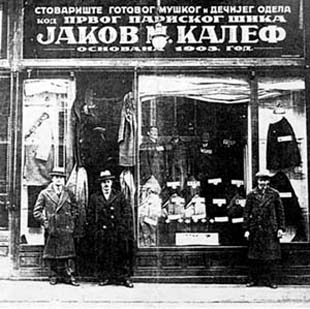
Trading and craftsmanship continued to be the most frequent professions among
Jews. There are many workshops - carpenters, shoemakers, tinkers, opticians,
tailors, photographers...But, there are also butchers, inn-keepers, kosher restaurants'
owners, hotel owners...
Many Jews went for high education, so there was an increased number of doctors,
lawyers, architects and artists of all profiles.
Statistically, more Jews worked in bankers' and merchants' trade and less in
industrial and craftsmen's vocations, more in free professions, less in public
services. Out of 2002 tax payers in the Sephard municipality before the Second
WW, 27% were merchants, 21% office clerks, 8% craftsmen and 4% doctors or engineers.
It would be wrong to think that all Jews from Dorcol were rich. About 74% of
households belonged to the lowest tax-paying group, and about 400 families did
not have to pay taxes at all, because they were too poor.

After Belgrade was bombed
in April 6, 1941, Nazi occupation of Yugoslavia began. It was the beginning
of the great suffering of Yugoslav people, especially Yugoslav Jews. Few days
after entering Belgrade, Gestapo launched measures "of settling the Jewish
issue." From April to August 1941, occupators listed Jewish citizens, marked
them with yellow ribbons, arrested them, threw them out of all offices and services,
took them away to enforced labor, killed them as hostages, and took them to
the concentration camp of Topovske Supe and then to death camps of Banjica and
Sajmiste. During the same period, several Jews were killed as individuals and
a group of Jews was shot as the retribution for the resistance movement's actions
in the city. In the "second stage", which lasted from August to October
1941, all Jewish males older than 14 were confined. In "the third stage,"
from October to December 1941, almost all those boys and men were killed.
Women and children were confined in the camp of Sajmiste in December 12. In
the last, "fourth stage," from January to May 1942, all remaining
men and all women and children were killed. Out of 11,870 Jews who lived in
Belgrade before the Second WW, 10,500 of them were killed.
Nazism destroyed whole Jewish life overnight. Jalija disappeared, Jewish Dorcol
disappeared, and all those specific characteristics of the Belgrade Jewish community
that existed until the Second WW.
Jewish survivors, with great efforts together with other citizens, participated
in renewal and rebuilding of the city, and in the renewal of their destroyed
community.